Reading Your Pet’s Mind: Training That Starts With Understanding
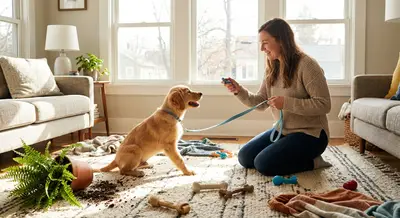
Most training advice jumps straight to commands and treats—but the real magic happens earlier, in the quiet moments when you’re watching, listening, and learning who your pet actually is. When you start from understanding instead of control, training feels less like a battle and more like a shared language you build together. This approach works whether you live with a confident dog, a shy cat, a chatty parrot, or a stubborn rabbit.
This guide focuses on that “in-between” space: how to read your pet, communicate clearly, and use science-backed techniques to shape behavior in a way that feels safe, respectful, and effective.
Your Pet Is Always Talking: How to Actually Notice
Before you can train anything, you have to see what’s already happening. Pets constantly send signals about how they feel—most of us just haven’t been taught to read them.
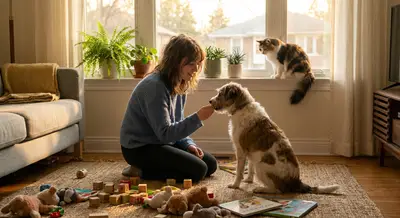
Start by watching your pet at three key times: during play, during rest, and when something new appears (a guest, a sound, a strange object). Notice posture, eyes, ears, tail, breathing, and movement speed. A loose, wiggly body usually signals comfort; a stiff, frozen posture is often early stress. Subtle cues—lip licking in dogs, tail twitching in cats, feathers slicked tight in birds, ears angled back in rabbits—can be your first warning sign that your pet is overwhelmed.
Keep a simple “behavior diary” for a week. Jot down what happened right before your pet reacted strongly (barked, hid, scratched, nipped, froze) and what happened right after. This helps you see patterns: the scary delivery truck, the doorbell, the vacuum, the cat walking past the dog’s bed. The better you get at seeing these patterns, the easier it becomes to change behavior without force.
The goal isn’t to label your pet as “good” or “naughty”—it’s to understand what they’re trying to cope with in each moment.
The Science Behind Kind Training (And Why Harsh Methods Backfire)
Modern animal behavior research is clear: pets learn best when they feel safe. Training based on fear, pain, or intimidation may stop a behavior in the moment, but it often creates new problems like anxiety, aggression, or shutdown.
Most everyday training uses a mix of:
- Positive reinforcement – your pet does something you like, and they get something they like (treat, toy, praise, access to you or the environment). This builds confidence and makes behaviors stronger and more reliable.
- Negative punishment (in a technical sense) – your pet does something you don’t like, and a good thing goes away briefly (for instance, you end a game when teeth touch skin). This is about removing rewards, not adding pain or fear.
What you want to avoid is punishment that adds fear or discomfort: yelling, leash jerks, spray bottles, shock or prong collars, pinning or “alpha rolling.” These can suppress communication—your pet may stop growling or hissing not because they’re comfortable, but because they’re afraid to warn you next time.
When pets know that good choices are consistently rewarded and scary things won’t be forced on them, they learn faster and trust more deeply. Training stops being a contest and becomes a partnership.
Setting Up the Game: Environments That Help Your Pet Win
Most “bad behavior” is really just your pet making the easiest choice available. You can use this to your advantage by setting up their world so the right choice is the simplest, most rewarding one.
Start with these environmental tweaks:
- Create a safe zone. Every pet needs a guaranteed quiet place: a crate, a covered bed, a high shelf, a separate room. Train a “go to your spot” cue by calmly rewarding your pet every time they choose that place, then gradually adding a cue word or hand signal.
- Manage temptation instead of arguing with it. Block off trash cans, use baby gates, secure counters and cupboards. It’s kinder (and less stressful) to prevent rehearsals of “bad” behavior than to constantly correct it.
- Match energy to outlet. High-energy dogs need legal ways to run, sniff, and think; young cats need vertical spaces and hunting-style play; intelligent birds and small mammals need puzzle feeders and foraging opportunities.
- Keep training sessions short and easy. Two to five minutes at a time is often enough, especially for young or easily stressed animals. Stop while your pet is still engaged, not when they’re exhausted.
When the environment supports success, your pet doesn’t have to “misbehave” just to meet their basic needs.
Building a Shared Language: Cues, Timing, and Consistency
Training is really just teaching your pet a predictable pattern: “When I see or hear this, doing that makes good things happen.” To build that pattern clearly:
- Choose simple, consistent cues. Use the same word and hand signal every time for a behavior (“sit,” “down,” “here,” “leave it”). Your pet doesn’t care which word you choose—they care that it’s consistent.
- Mark the exact moment they get it right. A clicker or a short marker word like “yes” helps your pet understand which action earned the reward. Say it as your pet does the right thing, not a few seconds later.
- Reward generously at first. In the learning phase, pay generously and often. Tiny, soft treats, a quick toss of a favorite toy, a chance to sniff a bush, or a released “go play!” can all be rewards, depending on what your pet loves.
- Ask, don’t demand. If your pet doesn’t respond, assume they’re distracted, confused, or stressed. Make it easier: move farther from distractions, break the behavior into smaller steps, or use a higher-value reward.
- Practice in different places. Pets don’t generalize well. A perfect “come” in your kitchen may fall apart at the park. Slowly add new locations and mild distractions so your pet learns, “This cue means the same thing everywhere.”
Think of this as teaching vocabulary in a new language, not “installing commands.” Each word is a shared agreement between you and your pet.
Turning Everyday Moments into Training Opportunities
You don’t need a formal “training time” to make progress. Some of the most powerful learning happens in ordinary moments:
- Door manners: Before opening a door to outside or to guests, wait for a brief moment of calm—four paws on the floor, a quiet sit, or even just a pause in barking. Mark and open the door as the reward. Over time, your pet learns that calm makes doors open faster.
- Mealtime magic: Ask for one simple behavior (sit, touch your hand with their nose, go to a mat) before the bowl goes down. The meal becomes a huge daily reward for cooperative behavior.
- Leash walking as a puzzle: Instead of dragging your dog into position, reward them with a tiny step forward every time the leash slackens. If it tightens, stop briefly; when they look back or move closer, mark and move forward again.
- Handling practice: While your pet is relaxed, pair gentle touches of paws, ears, or tail with treats, then slowly introduce brief nail clipper or brush exposure. Keep sessions very short and end before your pet gets worried.
By linking rewards to behaviors you like in everyday situations, you create a lifestyle of gentle training instead of rare, intense sessions.
When Fear, Reactivity, or Aggression Shows Up
Some behaviors—lunging at other dogs, biting during handling, intense fear of noises—are too complex or risky to tackle alone. These are often rooted in fear, pain, or past experiences, not stubbornness.
Here’s a safer, science-based starting point:
- Increase distance. If your dog explodes at passing dogs, start far enough away that they can notice the other dog but still eat treats and respond to you. That distance is part of the training plan.
- Pair scary things with good things. Every time your pet notices the “trigger” (another dog, a stranger, the vacuum), calmly feed high-value treats or offer a favorite toy, then remove them from the situation while they’re still calm. Over many repetitions, the trigger can start to predict good outcomes instead of fear.
- Watch for subtle stress signs. Yawning when not tired, turning the head away, widening eyes, sudden sniffing, grooming, or scratching can all be early “I’m not okay” signals.
- Check for pain. Sudden behavior changes, growling when touched, or reluctance to be handled may indicate discomfort. A veterinary exam is critical before assuming the issue is purely “behavioral.”
For biting, serious reactivity, or intense fear, seek help from a credentialed behavior professional who uses positive, evidence-based methods. Look for certifications like CAAB, DACVB, KPA-CTP, or CBCC-KA, and avoid anyone who relies on dominance language or punishment-heavy tools.
Training for a Lifetime, Not Just for Problems
Training isn’t just for fixing what’s “wrong”—it’s one of the best ways to enrich your pet’s life and deepen your bond.
Consider adding:
- Fun tricks: Spin, high-five, nose touch to your hand, target a mat, weave through your legs. These build communication skills and body awareness and can be amazing confidence boosters for shy animals.
- Scent work and foraging: Scatter part of your pet’s meal in a snuffle mat, cardboard box, or safe puzzle toy. For dogs, simple scent games like “find the treat” or “find the toy” tap into natural instincts and tire them mentally.
- Choice-based interactions: Let your pet choose when to approach and when to leave. During grooming or handling, teach a “start button” behavior (like standing on a mat or touching your hand) that means, “Yes, I’m ready—please continue.” If they step away, pause and let them come back when ready again.
When training is woven into play, exploration, and daily routines, your pet learns that life with you is predictable, safe, and full of chances to succeed.
Conclusion
Effective training doesn’t start with commands—it starts with curiosity. When you slow down enough to notice how your pet communicates, shape their environment thoughtfully, and use rewards to build a shared language, training becomes less about control and more about collaboration.
Your pet doesn’t need you to be perfect. They need you to be observant, patient, and willing to adjust the picture so they can understand what you’re asking. Over time, those small, kind choices add up to something powerful: a relationship where your pet trusts that you’ll listen, protect, and teach them in a way that feels safe.
That trust is the foundation of every behavior you’ll ever train—and it’s the part your pet will remember most.
Sources
- American Veterinary Society of Animal Behavior – Position Statement on Humane Dog Training - Summarizes current scientific understanding of effective, welfare-friendly training methods
- American Kennel Club – Understanding Dog Body Language - Explains key canine body signals and what they can mean in different contexts
- International Association of Animal Behavior Consultants (IAABC) - Provides position statements and guidance on behavior modification and professional standards
- Cornell University College of Veterinary Medicine – Behavior Resources - Offers educational material on behavior, stress, and training, with a focus on cats but broadly relevant principles
- Merck Veterinary Manual – Principles of Behavior Modification - Reviews learning theory, reinforcement, and behavior modification techniques used in veterinary behavioral medicine